Lemo-Opuscar: Claude makes short films in 43 styles, entirely in code
- film styles
- 43
- GitHub stars
- 1.4K
- video models used
- 0
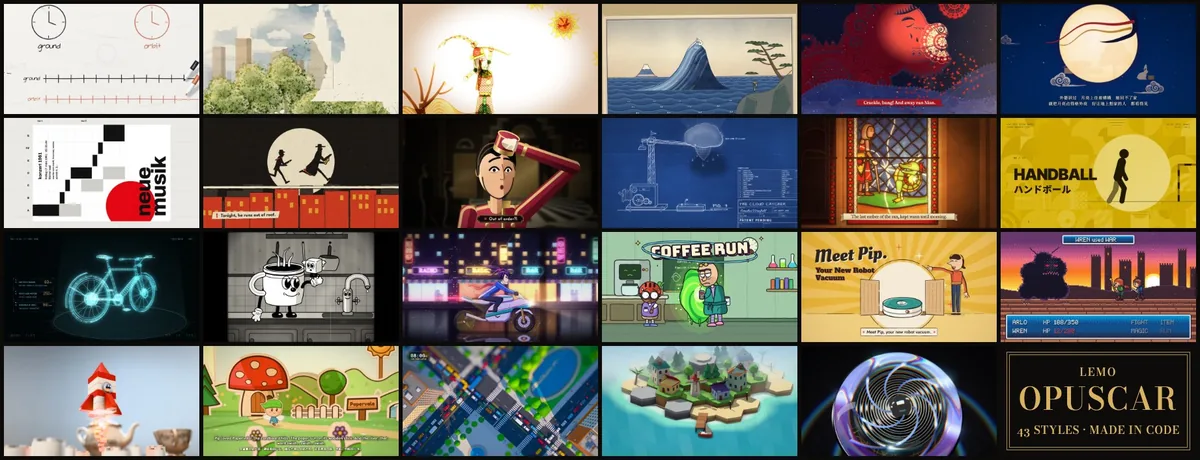
No video model, no stock footage. You pick a style, like watercolor, 80s anime or a 1920s silent film, tell Claude your story, and it directs the whole short film in code: every frame, the music and the narration.
What it is
A Claude Code skill with 43 film styles. Each style comes with a style guide and a demo film the author made with Claude Opus 5.5. Open source. How a film gets made:
- Questions first: it asks once about your topic, whether you have your own voice, music or footage, and if you want a storyboard.
- Directing: guides for story, sound, rhythm, camera and self-checks, plus a guide for the chosen style.
- Drawing: canvas and WebGL pages rendered frame by frame.
- Sound: original music from free sample libraries and text-to-speech narration.
- Output: a finished 1920 by 1080 film at 24 frames per second. Other sizes on request.
The showpiece is OPUSCAR 98, a 6.5-minute film where one little Clawd walks through all 98 Best Picture winners, each redrawn in its own style.
Steps
Step 1. Watch the gallery
Open the gallery and pick a style you like. Every style has a short demo film.
Step 2. Paste the prompt in Claude Code
Open Claude Code in an empty folder for your film and paste the prompt with your style and story. Claude installs the skill and the programs it needs.
Step 3. Check the storyboard
Ask for a storyboard first. Claude stops once to show the key shots in the real style, then makes the film.
Copy this into Claude Code
Install the lemo-opuscar skill from github.com/lemomo-ai/lemo-opuscar as a Claude Code plugin and check that it works. Check whether I have Node 20 or newer, ffmpeg and Python 3.11 or newer, and install whatever is missing. Then make a 45-second film in the [style name, for example watercolor] style about [your story in one or two sentences], with a [warm female or calm male] narrator. Show me the storyboard before you make the full film. If something doesn't install, explain what the problem is and fix it. I'm not a programmer: anything you can do yourself, do it yourself.
Want this working for your business?
- AI agents for your business
- Automations for the work you repeat
- 1:1 consulting calls
Good to know
Use your own material
Tell it if you have your own voice recording, music or footage, and it builds the film around them.
Start short
A film takes about 30 to 60 minutes of agent work. A 30 to 45 second film is the best first test.
Explainers too
Not just stories: whiteboard, data storytelling, isometric infographic and product launch styles work for explaining a product or an idea.
The honest read
- The styles are tuned for Claude Opus 5.5. The author says other models may not reproduce them.
- One film takes 30 to 60 minutes and, in the author's words, a fair amount of tokens.
- GitHub doesn't show a license for this repo. The LICENSE file is MIT text with one added note: third-party assets in the demos, like samples, fonts and voices, keep their own licenses, and you're responsible for what you use in your films.
Want this built for your business?
I build AI agents and automations for businesses, and do 1:1 consulting calls. Message me on Instagram with what your business does, and I'll tell you what can be automated.
Message me on Instagram